Showing posts with label ethereum. Show all posts

Why Ethereum is the Future of Blockchain

The blockchain platform with the most utility, developers and the dApp framework that is the most scalable, will win and take over the mantle from Bitcoin, as the heir apparent of blockchain innovation.
It would be hard to argue that in 2018, that’s not Ethereum. Its spawned countless ICOs, and has the most developers by far globally working on it. As of October 2017, according to CNBC it had at least 35,000 developers. In 2018, some believe that number is closer now to 200,000. That is according to Kevin Rooke, a cryptocurrency researcher and YouTuber.

Ethereum: the Handmaid of Decentralization

Few blockchain projects embody the spirit of decentralization as soundly as Ethereum and Vitalik Buterin. Ethereum is built on a newer generation of blockchain technology and is optimized for software engineers. With advances in sharding and plasma it has a decent chance of overcoming its scalability issues sooner rather than later.
A reported 94 out of the top 100 blockchain projects have launched on top of the Ethereum network. Ethereum as of mid 2018 has a market cap of $52.3 billion USD, but that doesn’t properly show its ubiquity as the leading dApp platform for developers and blockchain startups.
The root problem with conventional currency is all the trust that’s required to make it work. The central bank must be trusted not to debase the currency, but the history of fiat currencies is full of breaches of that trust. — Satoshi Nakamoto

Ethereum: the Blockchain Platform Devs Want to Work On

Ethereum’s commitment to a scaling strategy and decentralization, likely most resonates with developers as the first-mover dApp platform of choice. While Bitcoin over the last decade evolved into a digital store of value, it didn’t scale in terms of a payments option for various reasons.
However Ethereum has increasingly established itself as the leading decentralized application platform. A landscape of competitors has emerged but without posing any immediate threats to changing this, which include among others: EOS, NEO, Cardano, Stellar, Qtum, ICON and now likely Tron have gained significant market valuation and presence in the global market, with their focus set on decentralized applications.
Who will blockchain startups and developers trust?
The list of those who are on Ethereum is too long to list, however even the most pragmatic solutions such as $2 billion China-based IoT blockchain network VeChain, exist on the Ethereum network. Tron is migrating to build a competitor to NEO, often referred to as the “Ethereum of China”. It’s uncertain if Cardano or EOS will have the technical superiority they claim to threaten Ethereum in the immediate future, or the next few years.
You will notice also Ethereum has substantial partnerships with enterprise level companies, including Amazon (AWS) in the cloud.
Whereas most technologies tend to automate workers on the periphery doing menial tasks, blockchains automate away the center. Instead of putting the taxi driver out of a job, blockchain puts Uber out of a job and lets the taxi drivers work with the customer directly. - Vitalik Buterin
As blockchain evolves, how it intersects with the Cloud, and how smart contracts become implicated in services, accessibility, the sharing economy and decentralization of utilities is collectively relevant. A Swiss town will pilot voting on the blockchain using Ethereum-based IDs. All the applications of blockchain on our lives isn’t even fundamentally clear yet, but adoption has accelerated and is accelerating.
With it, the interest of software engineers, developers and coders is also at an all-time high. If hacks and BTC manipulation probes devalues Bitcoin’s price, Ethereum is free from being such a pioneer, it can be a first-mover at the intersection of enterprise and decentralization and blockchain startups. While ICO regulatory pressure has decreased their total funding in 2018, if we discount EOS and Telegram which are basically anomalies, Ethereum is pivoting to more practical use-cases.
Blockchain may not be the future of business quite like artificial intelligence and the cloud are, but it’s certainly becoming an important protocol with added ROI and obvious benefits.
In the concepts of open-source projects and decentralization, developers are attracted to the dynamic innovation of the space. Even Wall Street is seeing an exodus of financial talent teaming up with software engineering to start new exciting projects. It’s not because of crypto, it’s largely because of Ethereum.
If ICOs fueled crypto hype in 2017, enterprise adoption of blockchain is changing how we collectively see blockchain tech in 2018. Blockchain is now ahead of quantum computing and super-computing in how this nascent tech is impacting innovation and the variety of new blockchain startups is astounding.
Image result for ethereum
The nature of Bitcoin is such that once version 0.1 was released, the core design was set in stone for the rest of its lifetime. — Satoshi Nakaomoto
While Bitcoin remains somewhat of a relic and a symbol, Ethereum is dynamic and must evolve to meet the demands of the times and as the dApp platform that’s the current leader.

Ideology and Trust Matters to Developers

Vitalik Buterin is also a respected figure whose clear idealism contrats much of the profiteering vibe of other crypto projects and altcoins. Ethereum doesn’t feel like a Microsoft of a Facebook, because of Vitalik’s youth and vision.
If we look at Google trends, and eliminate the big three of San Francisco, Seattle and New York, in what U.S. cities do you suppose searches for Ethereum are taking place in the last year?
  • Austin
  • L.A
  • San Diego
  • Boston
  • Denver
  • Miami
  • Washington
  • Chicago
So basically a who is where of where young developers are at. That some of the most talented developers and entrepreneurs are attracted to the blockchain space is exciting. However globally, China by far rules the number of Ethereum searches. You must therefore conclude that a lot of important work of blockchain startups is actually occuring in China.
In a world of increasing complexity, the blockchain’s biggest unique value proposition may be how to handle and solve the problem of trust, accountability and security at the intersection of myriad industries and their sub-verticals. Let’s be realistic, these issues are intensifying and have a nearly universal application across value chains.
As society becomes more and more complex, cheating will in many ways become progressively easier and easier to do and harder to police or even understand. — Vitalik Buterin
Young people and consumers and citizens require another level of trust in the system, in apps, in services, in government, in politics, in corporate sustainability. Greater decentralization can manifest on the blockchain. Ethereum can be a vehicle for that.
Wealthy societies around the world are facing a growing crisis of confidence in established authorities. Stagnating economies, mounting inequality, political corruption and the increasing monopolization of technology for the benefit of elites have provoked a populist backlash. — Vitalik Buterin.
The biggest company with a crisis of trust Facebook, has even announced that it will integrate blockchain into its business model. Coinbase is scrambling to secure the popularity of its app and to secure its future viability. Stronger Asian led blockchain and crypto solutions are also inevitable. TRON is exceedingly ambitious, and NEO claims many advantages over Ethereum. China can accelerate blockchain projects and will likely do so immensely in the 2020s. However can they attract developers away from Ethereum’s platform?
If Bitcoin is shrouded in controversy, Ethereum is bathed in possibility. In a way they are the Yin and Yang of cryptocurrencies. On a Web 3.0 running smart contracts with 5G, what will be possible? In an IoT of everything, what kinds of blockchain systems will be in place? We are about to find out.
Share:

Authentication- Ethereum and Smart Contracts Part 4

Conclusion

We have taken our simple authentication for Ethereum accounts concept from our previous post and expanded it to make it more convenient. Let's review our design goals from the beginning of this post:
  • It should allow users with an Ethereum address to use that address to log in to a third-party website (that supports this login method). After registration, users can log in to any site implementing this protocol using their Ethereum address or email address.
  • It should be easy to use and reasonably easy to setup. It is simpler than our previous example and simple enough for typical Ethereum users: one mobile app to install, one transaction to execute once.
  • It should not compromise the security of the user's Ethereum account. Logins are now handled using a separate Ethereum account so the user does not need to expose his valuable Ethereum account.
  • It should allow users to recover their credentials in case of loss or theft. In the case of theft of the mobile device, the user can create a mapping to a new account for logins using his primary Ethereum address.
  • It should not require knowledge of contracts or manually calling contract methods. The mobile wallet app and Metamask combined to isolate users from interacting with contracts directly.
  • It should have reasonable latency for a login system (no more than a couple of seconds). Logins are only affected by network latency between the authentication server and the mobile device. In other words, they are as fast as any login system.
  • It should not cost users gas (or money) to log in. Users only spend Ether once when first setting up their account. After that, logins to any third party websites do not use gas or Ether.
  • It should be reasonably easy for developers to implement in their apps. Developers can implement this by calling two endpoints of a RESTful API. Really simple.
Not bad for our initial research into integrating Ethereum with classic technologies. This shows Ethereum can be integrated into traditional applications today. The platform works, and the concept of decentralized applications is picking up steam.
Share:

Authentication- Ethereum and Smart Contracts Part 3

Try It Out!

Since this is just a proof-of-concept and getting your feet wet with Ethereum can be a bit hard at first, here is a step-by-step guide for new users to test the system. Please note that this is just a test system so it uses Ethereum's testnet. In other words, no hard guarantees are provided with regard to the integrity of the data stored in the Ethereum testnet, do not put important stuff in the accounts created in this guide, they won't be protected by the same guarantees as the Ethereum mainnet.

Get an Ethereum Wallet

To perform operations in Ethereum you need a wallet. A wallet is an application that allows you to interact with the rest of the network. Wallets store the private-keys for your Ethereum addresses. For simplicity, we will be using Metamask. Metamask is a browser-based wallet that runs locally as a Chrome extension. Keys are stored locally and transactions are signed with them. These are then sent to the rest of the network through a Metamask operated public node.

1. Get Metamask

Go to the Chrome Webstore and install Metamask.

2. Create a New Account

Click on the Metamask icon on the top right corner of your Chrome windows and follow the wizard to create an account. Make sure it is created in the Rinkeby testnet. To check this, after creating the account, click on the icon next to the Metamask fox, on the top left corner of the Metamask window. If you are using another network, just switch to Rinkeby and then follow the wizard again.

3. Get Some Ether

To register you will need a minimum amount of Ether. Fortunately, this is easy to get in the testnet (in the mainnet you must either buy it or be lucky enough to be able to mine it). For the testnet it is possible to use "faucets." Faucets are places to get free Ether. The most popular Rinkeby faucet requires users to create a GitHub gist. This is a simple way to limit misuse of the faucet. Creating gists is easy, you only need a GitHub account. Crate a public GitHub gist and paste your Metamask Rinkeby address in it. Then go back to the faucet and place the link to the gist in the required field, then click on "Give Me Ether" (the faucet is located in the crypto faucet section on the left bar).
After a bit, you should see your newly acquired Ether in Metamask.
To get your Rinkeby Ethereum address, go to Metamask and then click on the "copy" icon next to your account name. This will be your primary Ethereum address. In an actual production system, this would be the address of an account with lots of Ether in it. One that you would not want to expose every time you want to login to some third-party site using your Ethereum address.

Get the Mobile Authenticator App

Now it's time to set up your secondary address and login helper app. This application will be the authentication factor used to confirm your login request. Any time you want to login to some site, you will receive a notification through this app. This notification will allow you to either confirm or deny the authentication request.

1. Get the App

Go to the Android Play Store and download our Auth0 PoC app.

2. Register

Open the app and input your email address. Now choose an unlock pattern. You will be asked to input this same pattern any time you want to login to a site. Then click Register. You will be asked to confirm the registration through the mobile app. Click Sign to confirm it.
The mobile app is now set, let's enable your Ethereum account for logins.

Enable Your Ethereum Address for Logins

This step, like the previous ones, is only performed once. This sets up the mapping between your primary address and the login address. In other words, it connects your Metamask account to the mobile app in your smartphone.

1. Get Your Mobile App (Secondary) Address

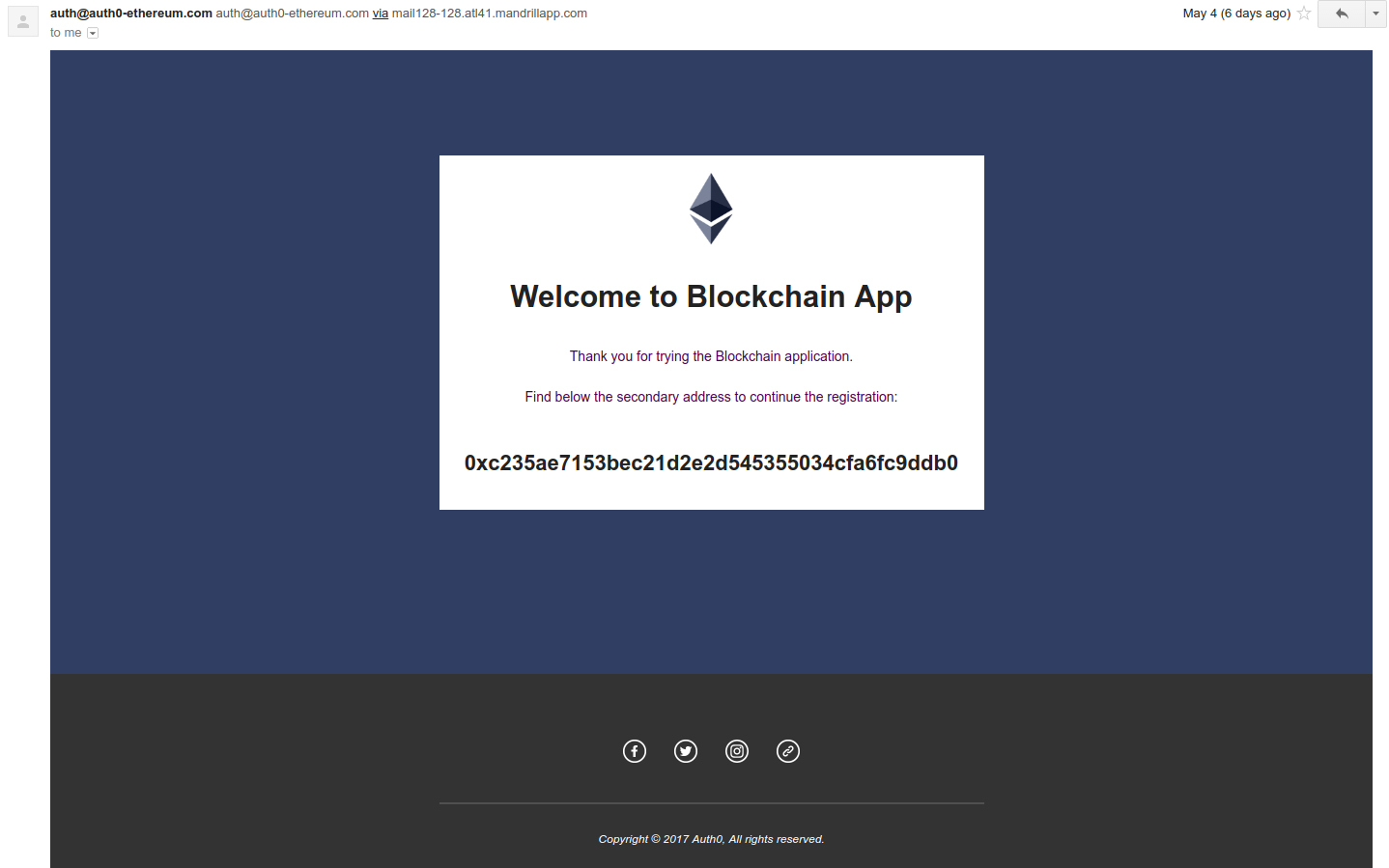
If you now look at your emails (please check spam, promotions, etc.) you will find your Ethereum secondary address. This is the address of the account managed through your smartphone. Just copy it to the clipboard.
Registration email

2. Call The Contract!

If you are an Ethereum user and you have your own wallet, you can perform this step manually. For simplicity, however, we have set up a site that will do the hard work for you. Using the same Chrome instance where you installed Metamask, navigate to our PoC wallet. This site is a simple local-only wallet-like app that creates the Ethereum transaction necessary to call the contract. This site communicated with Metamask so that you don't have to input your account details manually.
Once you are in the site, paste the Ethereum address you copied from the email in the previous step and click Register. A Metamask window will pop-up. This is a confirmation that you are about to make a transaction from your primary account that will spend Ether. Click Sign. After a while your primary and secondary accounts will be connected! The time for this to happen depends on the Ethereum network. In general it is just a few seconds.
In case you are already experienced with Ethereum you may want to perform this step manually. Call the mapAddress method of the Mapper contract located at 0x5e24bf433aee99227737663c0a387f02a9ed4b8a. You can get the JSON API here. The only parameter is the address you got in your email.
After this is done everything is set!

Login to Our Test Site

You may now login to any third party site that supports this authentication method using either your email address or your primary Ethereum address as a credential. Go to our sample website, put in your email address and click Login. Watch your smartphone for notifications to approve your login.
You will notice there is a checkbox labeled Trustless Authentication. As explained before, third parties may opt for different levels of security. They can opt to trust the authentication server when it says the login is valid (trustful authentication) or they may opt to not trust the authentication server and validate the signature internally. In this case, the third-party website must validate the signature of the secondary address itself, first be querying the secondary address using the Mapper contract (which is publicly available) and then by verifying the signature of the returned data using the secondary address to find the public key of the secondary address. This provides the highest level of security and uses the authentication server as simply a messenger.
Share:

Authentication: Ethereum and Smart Contracts Part 2

Towards a Practical Authentication Solution for Ethereum Users

Authentication is what my team does at Auth0, so we teamed up with the guys from GFT's Innovation Team to think of a better way of using Ethereum for this purpose. We came up with a proof of concept which we will share with you in this post. First, let's describe the design goals for our system:
  • It should allow users with an Ethereum address to use that address to log in to a third-party website (that supports this login method).
  • It should be easy to use and reasonably easy to setup.
  • It should not compromise the security of the user's Ethereum account.
  • It should allow users to recover their credentials in case of loss or theft.
  • It should not require knowledge of contracts or manually calling contract methods.
  • It should have reasonable latency for a login system (no more than a couple of seconds).
  • It should not cost users gas (or money) to log in.
  • It should be reasonably easy for developers to implement in their apps.
One of the biggest problems with our initial approach was that writes were necessary. This forced users who wanted to log in to spend Ether to do so. Worse, they had to wait for confirmation of the transaction before the login was successful. On the other hand, this made the login process truly decentralized.
Writes were a requirement for our previous system due to the way Ethereum events work. Events are special operations in the Ethereum network that can be watched by nodes. Internally, events are Ethereum Virtual Machine ops that create data that is added to the transaction when it is mined. Events do not work on read-only (constant) Solidity functions since they are added to a transaction when it is mined. This forces users of our first system to pay to generate aLoginAttempt event.
This limitation forced us to make a compromise: rather than remain entirely decentralized, we added a server to handle authentication requests. In turn, this server relies on data stored in the Ethereum blockchain. However, our system does retain the ability to allow for serverless logins. We will see how that works later on.
Another big limitation of our first system was that the user needed access to his Ethereum wallet to log in. This is impractical for several reasons:
  • Users usually keep a single wallet. In other words, they do not carry around their private keys to easily use them on different devices.
  • If a user loses his or her Ethereum private key, he may never be able to authenticate again with that address to a third party service, not even to switch his main address or recover his information. This poses a problem for long-term use of the system.
  • Requiring a user to use his or her private key for each login can be a security issue for accounts holding big amounts of value. For those accounts, private keys may be stored safely and used only when necessary. Requiring their use for each login is less than ideal.
So some way of using an Ethereum address to login without requiring the private key for that address must be implemented for our new system.

A Login System for Ethereum Users

So, here is what we implemented. Our system relies on three key elements: an authentication server, a mobile application, and the Ethereum network. Here's how they play together.
Architecture
To keep the user's Ethereum address separate from the authentication process, a different, authentication only, Ethereum address is generated by the system. This address is associated with the user's Ethereum address using an Ethereum contract. In other words, a mapping between the user's Ethereum address and the system's login-only address is established. This mapping is stored in Ethereum's blockchain with the help of a contract.
pragma solidity ^0.4.2;
contract Mapper {
    event AddressMapped(address primary, address secondary);
    event Error(uint code, address sender);
    mapping (address => address) public primaryToSecondary;
    mapping (address => bool) public secondaryInUse;
    modifier secondaryAddressMustBeUnique(address secondary) {
        if(secondaryInUse[secondary]) {
            Error(1, msg.sender);
            throw;
        }
        _;
    }
    function mapAddress(address secondary) 
        secondaryAddressMustBeUnique(secondary) {
        // If there is no mapping, this does nothing
        secondaryInUse[primaryToSecondary[msg.sender]] = false;
        primaryToSecondary[msg.sender] = secondary;
        secondaryInUse[secondary] = true;
        AddressMapped(msg.sender, secondary);
    }
}
Although this contract is a bit more complex than we have seen so far, it remains fairly accessible. Let's break it down:
  • There are two events: AddressMapped and Error. The AddressMapped event is generated any time a user's primary Ethereum address is mapped to a secondary, login-only, address. The Error event is only generated in case of errors, such as when a mapping using an existing secondary address already exists.
  • Then two variables are declared: primaryToSecondary and secondaryInUseprimaryToSecondary is a map of addresses: given the primary address, it can tell the secondary address mapped to it. secondaryInUse is a map of addresses to booleans, used to check whether a secondary address is already in use.
  • Next, comes secondaryAddressMustBeUnique. This special function is a modifier. Modifiers in Solidity are special functions that can be attached to contract methods. These runs before the method code and can be used to modify their behavior. In this case, secondaryAddressMustBeUnique uses the secondaryInUse variable to confirm whether the secondary address passed as a parameter is in use. If it is, this is flagged as an error and the Error event is emitted. If it is not in use, then execution continues. The _ placeholder is where the code from the modified function is logically inserted.
  • And lastly, there is the mapAddress method. This method takes a secondary address and maps it to the address of the sender or caller of this method. The semantics of Ethereum make sure that the sender is who he says he is. In other words, only the owner of the private key for an address can make calls as the sender to a Solidity method. This makes sure, without any special check, that only the rightful owner of the primary address can establish a mapping between it and a secondary address used for logins. This is the crux of our system.
In summary, our contract does four things:
  • It establishes a mapping between two Ethereum addresses: one high-value address (the primary address) and a low value, login-only, secondary address.
  • It certifies only the owner of the primary address can establish this mapping.
  • It records this information publicly in the blockchain.
  • It emits events to monitor and react to changes in the data stored in it.
This is all we need to make our system work. Let's go over the full registration and authentication flow to see how it all works together. We assume the user is the rightful owner of an Ethereum account with a certain amount of Ether.

Registration

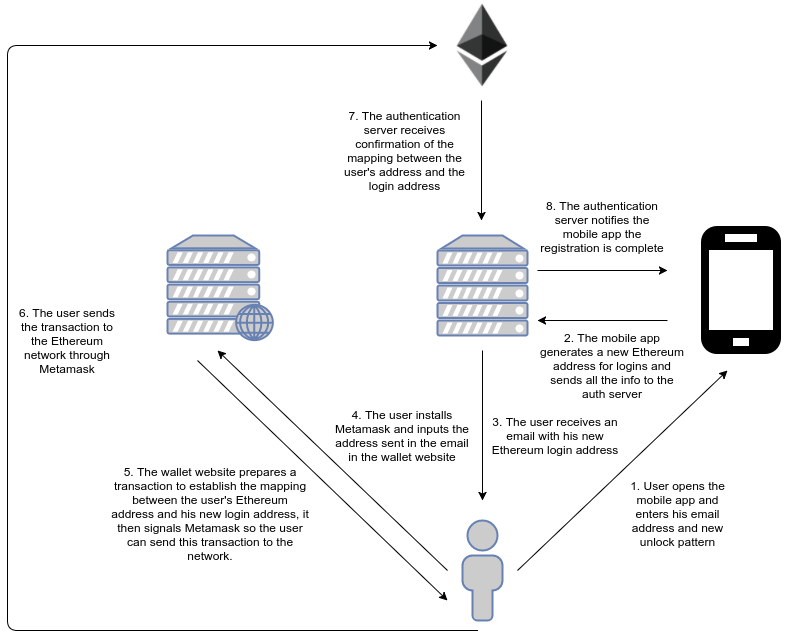
Registration
This is a one time only step to be performed the first time the user tries to use the system. Once registered, the user can use his or her Ethereum address with any third-party website. In other words, this is a system-wide, one time only step.
To simplify the authentication experience, our implementation uses a mobile application to authorize or deny authentication requests. A user who wants to enable his Ethereum account for use as an authentication factor first registers through the mobile application.
Registration is performed by following these steps:
  1. The user opens the mobile application.
  2. The user enters his or her email address and an unlock pattern.
  3. A new Ethereum address is generated behind the scenes by the mobile application. This is the secondary address. This address is sent to the user to his or her email for convenience.
  4. The user establishes a link between his or her primary Ethereum address and this secondary address. To do so the user can manually call the mapAddress method of the Mapper contract or use a special wallet app developed for this purpose. This step requires the user to spend a minimum amount of gas from his primary account.
  5. Once the link between addresses is established, the mobile application will show a confirmation dialog. If the user confirms, the mapping is established and the process is complete.
One of the added benefits of this approach is that it makes throwaway accounts harder to use. Point 4 forces the user to spend Ether to establish the mapping between his personal Ethereum address and the login-only address. This way, third-parties can be sure that the Ethereum account used by the user is not a throwaway account (i.e. a spam account).

Authentication

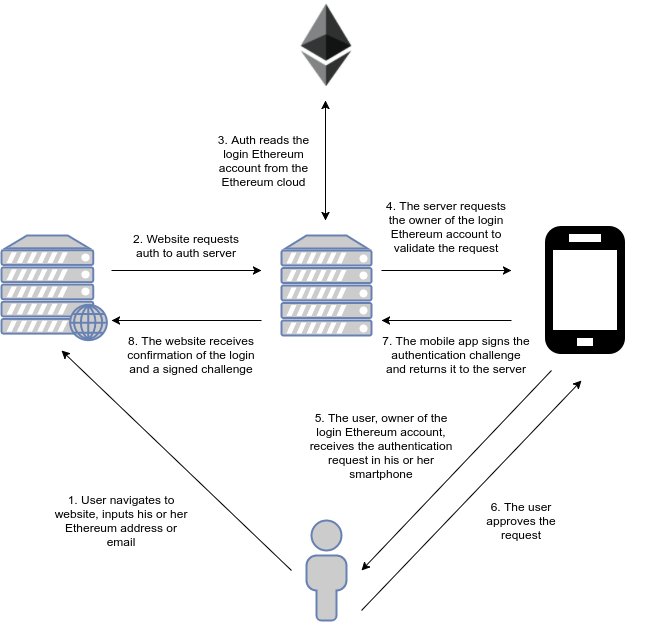
Authentication
Whenever a user who has already registered wants to use his or her Ethereum account to login to a third-party website, he or she follows this process:
  1. The user inputs his or her primary Ethereum address or his or her email in an input field and clicks "Login."
  2. The third-party website contacts the authentication server requesting authentication for that address. To do so the third-party website generates a challenge string with a specific format and passes it to the authentication server.
  3. The authentication server checks the Ethereum network for the current secondary address of the user. It then checks the internal database for the necessary data to contact the mobile device associated with that address.
  4. The user receives a mobile push notification to confirm or deny the login request.
  5. If the user accepts, the private key of the secondary address is used to sign the challenge. The signed challenge is then sent back to the authentication server.
  6. The authentication server verifies the signature and if it is valid and the challenge matches, it considers the login successful. It then sends back the signed challenge to the third-party website for optional independent confirmation.
That is all there is to it, really! This scheme separates the signature process from a sensitive primary address, preventing the exposure of a potentially important private key while still giving the third party site confirmation that the user is the rightful owner of that address. Furthermore, although it relies on the authentication server for convenience, it can still work without it and does not require trust to be placed in it (the third-party website can check the signature itself). Thus it remains decentralized in worst-case scenarios (authentication server down) and convenient for the common case.
As an added benefit, this system can easily be adapted to work like "Login with Facebook" or "Login with Google" as well.

Cons

As we have seen so far, our system appears to be more convenient than our initial, simple approach from the "Programmable Blockchain" of this series. However, it does come with a few limitations of its own. Let's take a brief look at them.
Our initial approach sported a key element from blockchain based systems: it was entirely decentralized. Our newer approach relies on an authentication server for convenience. Although it is possible for the system to work without the authentication server, it is not convenient to use it this way. This is by design and must be considered if a convenient decentralized operation is mandatory in all cases. In every case, however, no trust is placed in the server.
Tune in tomorrow for Part 3, where we'll discuss getting your Ethereum Wallet set up and how to use it. 
Share:

Labels

Contact Us

Name

Email *

Message *

Recent Posts

Info